

 Post by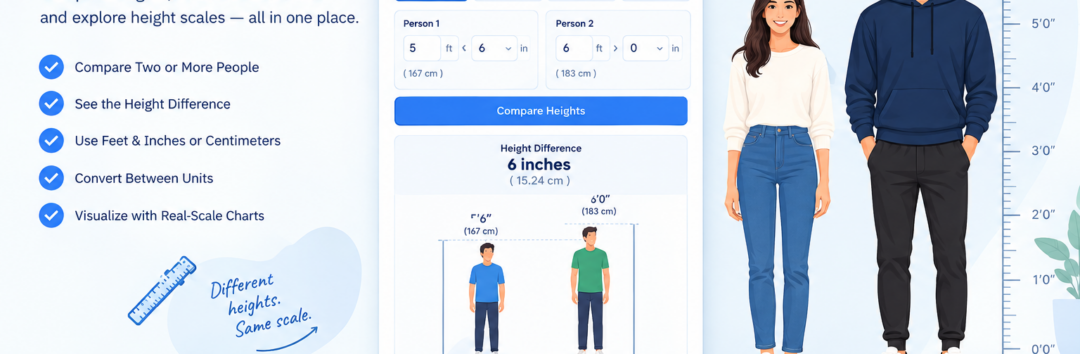
Height Comparison Tool: Compare Heights, Visualize Differences & Understand Height Differences
Have you ever wondered what a 5’2″ person looks like standing next to someone who is 6’0″? Or how much taller one person really is when the difference is 8, 10, or 12 inches?
Height can be surprisingly difficult to visualize from numbers alone. A measurement such as 175 cm or 5 feet 9 inches tells you how tall someone is, but it does not immediately show you how that height compares with another person.
That is where a height comparison tool becomes useful.
A height comparison tool allows you to enter two or more heights and instantly see the difference between them. Depending on the tool, you may be able to compare measurements in feet and inches or centimeters, create a visual representation of people standing next to each other, and explore the difference through an interactive chart.
These tools are useful for everyday curiosity, education, entertainment, design, character creation, sports analysis, photography planning, and many other situations where understanding relative height matters.
For example, imagine comparing someone who is 5’4″ with someone who is 6’2″. The numerical difference is easy to calculate, but a visual representation makes the difference much easier to understand. Instead of simply seeing two measurements, you can see the approximate height relationship between the two people.
A modern height comparison calculator can make this process almost instant.
Whether you want to compare your height with a friend, understand a celebrity’s height, visualize a fictional character, compare multiple people, or simply explore how different measurements look side by side, a height comparison tool provides a simple way to turn numbers into something visually understandable.
Click Here To Try Height Comparison Tool
What Is a Height Comparison Tool?
A height comparison tool is an online calculator or interactive visual tool that allows users to compare the heights of two or more people, characters, animals, or objects.
The basic concept is simple.
You enter one height, enter another height, and the tool calculates the difference. More advanced tools then display that difference visually.
For example:
Person A: 5’5″
Person B: 6’0″
The tool can calculate the numerical difference and create a visual representation showing how the two heights relate to each other.
This is particularly helpful because humans are generally better at understanding visual relationships than isolated numerical measurements.
If someone tells you that Person A is 15 cm shorter than Person B, you understand the basic fact. But if you see two silhouettes standing side by side, the difference becomes immediately obvious.
A good height comparison tool therefore combines calculation with visualization.
From numbers to visual understanding
A basic height calculator may only provide a numerical result:
Difference = 7 inches
A more advanced tool can provide:
- Height in feet and inches
- Height in centimeters
- Difference in inches
- Difference in centimeters
- Side-by-side visual comparison
- Height scale comparison
- Multiple-person comparison
- Height charts
- Conversion between measurement systems
This makes the tool useful to a much wider audience.
Someone planning a photo shoot may want to understand how two people will appear together. Someone writing a story may want to visualize the difference between characters. A sports fan may want to compare athletes. Someone researching celebrity heights may want to compare two actors.
The underlying calculation is simple, but the visual presentation makes the information much more useful.
How Does a Height Comparison Tool Work?
At its core, a height comparison tool performs a relatively straightforward mathematical process.
Suppose one person is 5’6″ and another is 6’1″.
First, the measurements can be converted into a common unit.
For feet and inches, the conversion can be expressed in inches:
5’6″ = 66 inches
6’1″ = 73 inches
The difference is:
73 − 66 = 7 inches
The same difference can then be converted into centimeters.
Since one inch equals 2.54 centimeters:
7 × 2.54 = 17.78 cm
So the two people are approximately 17.78 cm apart in height.
A digital tool performs these calculations automatically.
The more interesting part is what happens afterward.
Instead of simply showing:
7 inches difference
a height comparison visualizer can represent both measurements using proportional silhouettes or figures.
This turns a mathematical calculation into a visual experience.
Height comparison in feet and inches
Feet and inches are commonly used in countries such as the United States.
A person’s height might be written as:
- 5’0″
- 5’4″
- 5’7″
- 5’10”
- 6’0″
- 6’3″
The apostrophe represents feet, while the quotation mark represents inches.
For example:
5’8″ = 5 feet 8 inches
A feet and inches height comparison tool allows users to enter measurements in this familiar format without manually converting everything into centimeters.
This is particularly convenient when comparing people whose heights are commonly reported in feet and inches.
Height comparison in centimeters
Centimeters are widely used internationally and are particularly common in countries using the metric system.
Examples include:
- 150 cm
- 160 cm
- 165 cm
- 170 cm
- 175 cm
- 180 cm
- 185 cm
- 190 cm
A centimeters height comparison allows users to enter these measurements directly.
For example:
Person A: 165 cm
Person B: 180 cm
Difference:
15 cm
A visualizer can then show the relative difference between the two measurements.
Why Visual Height Comparison Is More Useful Than Numbers Alone
Numbers are precise, but they are not always intuitive.
If someone says that one person is 12 cm taller than another, you may understand the statement mathematically but still have difficulty imagining what that difference looks like.
This is why visual height comparison is such an important feature.
A visual comparison typically represents each person using a scaled figure or silhouette.
For example:
Person A       Person B

   O              O
  /|\            /|\
  / \            / \
 5'4"            6'0"
The exact design can vary, but the principle is the same: both figures should be represented proportionally.
This helps users understand relative height quickly.
What is a height scale comparison?
A height scale comparison represents people or objects according to a common visual scale.
Imagine a vertical ruler extending from the floor upward.
Person A reaches 5’4″.
Person B reaches 6’0″.
Instead of displaying two unrelated numbers, the tool positions both figures against the same scale.
This provides immediate context.
The same principle can be applied to:
- People
- Children
- Adults
- Athletes
- Celebrities
- Fictional characters
- Animals
- Objects
The important part is maintaining proportionality.
If a visual tool represents a 6-foot person only slightly taller than a 5-foot person, the visualization becomes misleading. A reliable height comparison chart should maintain a consistent scale.
Height Comparison Chart: A Simple Way to Understand Differences
A height comparison chart provides another way to understand relative height.
Instead of comparing only two measurements, a chart can display a range of heights.
For example:
| Height | Centimeters | Feet & Inches |
|---|---|---|
| 150 cm | 150 cm | Approx. 4’11” |
| 160 cm | 160 cm | Approx. 5’3″ |
| 170 cm | 170 cm | Approx. 5’7″ |
| 180 cm | 180 cm | Approx. 5’11” |
| 190 cm | 190 cm | Approx. 6’3″ |
Such a chart can be useful when someone wants to quickly understand the relationship between metric and imperial measurements.
A more advanced height comparison chart generator can create a customized chart based on the user’s selected heights.
For example, a user could enter:
- 5’2″
- 5’7″
- 6’0″
- 6’3″
The system could automatically generate a visual chart displaying all four heights on the same scale.
This is particularly useful when comparing multiple people rather than just two.
Height Difference Calculator: Calculate the Exact Difference
A height difference calculator focuses on one simple question:
How much taller or shorter is one person than another?
Suppose:
Person A = 5’5″
Person B = 5’11”
Convert both measurements to inches:
5’5″ = 65 inches
5’11” = 71 inches
Difference:
71 − 65 = 6 inches
The difference is therefore 6 inches, which is approximately 15.24 cm.
The tool can present this result in a simple format:
Height difference: 6 inches / 15.24 cm
This is particularly useful because people often want to know the difference rather than the absolute measurements.
For example:
- How much taller is 6’0″ than 5’5″?
- How much shorter is 5’2″ than 5’8″?
- What is the difference between 170 cm and 185 cm?
- What does a 10-inch height difference look like?
The calculator can answer each question instantly.
Understanding small height differences
Not every comparison involves a dramatic difference.
A tool can also help visualize smaller differences such as:
- 1 inch
- 2 inches
- 3 inches
- 4 inches
- 5 inches
A 1-inch difference may be difficult to notice in a photograph depending on posture, footwear, camera angle, and perspective.
A larger difference is generally more visually obvious.
The tool should therefore separate the mathematical difference from the visual appearance.
Height Conversion: CM to Feet and Inches
Another important feature is height conversion (cm to ft/in).
People around the world use different measurement systems.
Someone may say:
“I am 178 cm tall.”
Another person may describe the same height using feet and inches.
Converting between the two systems makes comparison easier.
The basic relationship is:
1 inch = 2.54 cm
Therefore:
178 cm ÷ 2.54 ≈ 70.08 inches
That is approximately:
5 feet 10 inches
A height comparison tool can perform this conversion automatically.
Common height conversions
Some commonly searched measurements include:
- 150 cm in feet
- 155 cm in feet
- 160 cm in feet
- 165 cm in feet
- 170 cm in feet
- 175 cm in feet
- 180 cm in feet
- 185 cm in feet
- 190 cm in feet
The reverse conversion is equally useful.
Users may search for:
- 5’0″ in cm
- 5’2″ in cm
- 5’5″ in cm
- 5’7″ in cm
- 5’10” in cm
- 6’0″ in cm
- 6’2″ in cm
Providing both directions creates a more complete height conversion experience.
Compare Two People, Couples, Celebrities and More
One of the most engaging applications of a height comparison tool is comparing real people.
The tool does not have to be limited to generic “Person A” and “Person B.”
It can support several different use cases.
People height comparison
A simple people height comparison allows users to enter their own measurements.
For example:
You: 5’8″
Friend: 6’1″
The tool can show:
- Individual heights
- Height difference
- Difference in centimeters
- Difference in inches
- Visual comparison
This can be useful for everyday curiosity.
Users can compare themselves with:
- Friends
- Family members
- Partners
- Teammates
- Colleagues
The experience becomes more engaging when the result is visual rather than purely numerical.
Couple Height Comparison
Another popular use case is couple height comparison.
People often want to visualize how two partners may appear standing next to one another.
For example:
Person A: 5’3″
Person B: 5’11”
A comparison tool can display both figures at the same scale.
It is important to distinguish between comparison and judgment.
There is no universal “correct” or “ideal” height difference for couples. People have different preferences and relationships, and height does not determine compatibility.
The purpose of a couple comparison tool is simply visualization.
A useful result might say:
Person B is 8 inches taller than Person A.
Then the tool can display the two figures side by side.
Users can experiment with different combinations to understand what specific height differences look like.
Celebrity Height Comparison
Celebrity searches create another interesting application.
A celebrity height comparison tool can allow users to select two public figures and compare their reported heights.
For example:
Celebrity A: 5’7″
Celebrity B: 6’2″
The tool can calculate the difference and display both figures visually.
Possible categories include:
- Actors
- Singers
- Athletes
- Musicians
- Models
- Television personalities
- Public figures
A celebrity comparison database can also include searchable profiles.
For example:
Celebrity Height
- Name
- Profession
- Reported height
- Height in centimeters
- Height in feet and inches
- Comparison options
However, celebrity height information should be handled carefully because reported heights can vary between sources. A high-quality website should avoid presenting uncertain figures as exact measurements.
Where appropriate, the page can use wording such as:
“Reported height”
or
“Approximately 180 cm”
This makes the information more transparent.
Multiple-Person Height Comparison
Why stop at two people?
A multiple-person height comparison allows users to compare three, four, five, or even more individuals simultaneously.
For example:
Person A — 5'3"
Person B — 5'7"
Person C — 5'11"
Person D — 6'2"
The visualizer can arrange them from shortest to tallest.
This feature can be especially useful for:
- Sports teams
- Cast members
- Families
- Friend groups
- Character groups
- Classrooms
- Research demonstrations
The tool could provide an automatic ranking by height while maintaining the original measurements.
For example:
Shortest → Tallest
5’3″ → 5’7″ → 5’11” → 6’2″
The visual representation makes the progression immediately understandable.
Height Difference Chart for Quick Comparisons
A height difference chart can make the tool even more useful for people who frequently compare common height combinations.
Imagine a page containing examples such as:
| Height A | Height B | Difference |
|---|---|---|
| 5’0″ | 5’6″ | 6 inches |
| 5’2″ | 5’8″ | 6 inches |
| 5’4″ | 6’0″ | 8 inches |
| 5’6″ | 6’0″ | 6 inches |
| 5’8″ | 6’2″ | 6 inches |
| 5’10” | 6’4″ | 6 inches |
Users can quickly find a combination close to what they are looking for.
A dynamic chart can go further by allowing users to select any two heights.
The system can instantly update:
- Numerical difference
- Centimeter difference
- Visual representation
- Relative scale
- Conversion information
Height Comparison by Gender
Some users may search for height comparison by gender, particularly when looking at population statistics or comparing average height datasets.
A tool or information page can present male and female height data separately when the underlying dataset supports that distinction.
However, this should be presented as statistical information rather than a rule about individuals.
Individual height varies considerably within every population.
A person’s height can be influenced by many factors, including genetics, age, nutrition, health, and environmental factors.
Therefore, an average height should not be treated as a prediction of how tall a specific person “should” be.
For a comparison website, this distinction is important.
A good page can say:
“Average height statistics describe populations. They do not determine an individual’s expected height.”
This keeps the information useful while avoiding unnecessary assumptions.
Comparing Characters, Objects and Animals
A height comparison tool does not have to be restricted to humans.
The same visual concept can be used for fictional characters, objects, and animals.
Character height comparison
A character height comparison is useful for fiction, gaming, animation, comics, movies, and creative projects.
For example, a user might want to compare:
- Two fictional characters
- Main character vs villain
- Human vs giant character
- Different versions of the same character
- Characters from different fictional universes
The important requirement is having a reliable reference height.
Once the heights are available, the visualizer can display the characters proportionally.
This can be particularly useful for artists and writers who need a quick reference.
Object height comparison
The same principle can be applied to objects.
For example:
- Person vs car
- Person vs refrigerator
- Person vs door
- Person vs tree
- Person vs building
An object height comparison helps users understand scale.
If an object is 2 meters tall, that measurement may not mean much visually.
Place a 2-meter object next to a 1.7-meter person, however, and the relationship becomes much easier to understand.
Animal height comparison
An animal height comparison can be another engaging feature.
Users might compare the approximate height of:
- Dogs
- Horses
- Elephants
- Giraffes
- Bears
- Kangaroos
- Other animals
Animal measurements require additional care because “height” can mean different things depending on the species.
For example, the height of a horse is commonly discussed at the withers, while some other animals may be measured differently.
A quality tool should clearly explain the measurement reference used.
What Makes a Good Height Comparison Visualizer?
Not every height calculator needs to be complicated.
The best experience is often simple:
- Enter the first height.
- Enter the second height.
- Select the unit.
- Click compare.
- View the difference.
- See the visual comparison.
But several features can make the experience substantially better.
1. Multiple measurement formats
Allow users to choose:
- Feet and inches
- Centimeters
- Meters
- Inches
Users should not have to manually convert their height before using the calculator.
2. Real-time conversion
If someone enters:
180 cm
the tool can immediately display:
5’11” approximately
This makes the interface easier to understand.
3. Accurate visual scaling
The visualizer should maintain a consistent scale.
If Person A is 160 cm and Person B is 180 cm, the second figure should appear proportionally taller.
The visual representation should not exaggerate the difference simply to make the result more dramatic.
4. Responsive design
A height comparison tool should work well on:
- Desktop
- Laptop
- Tablet
- Mobile
Many users will access a simple comparison tool from a phone, so mobile usability is especially important.
5. Multiple-person support
Allowing several measurements can transform a basic calculator into a more useful visualization platform.
6. Shareable results
Users could receive a unique comparison result or generate an image they can share.
For example:
5’4″ vs 6’0″ — 8-inch difference
This makes the tool more engaging for social sharing.
How to Build a Better Height Comparison Experience
If you are creating a height comparison website, the calculator itself should be only the beginning.
A strong product can combine tools, educational content, charts, and searchable comparison pages.
The homepage
The homepage can focus on one central experience:
Compare Heights Instantly
Enter two or more heights and see the difference visually.
Inputs:
Person 1
Feet: [5]
Inches: [5]
Person 2
Feet: [6]
Inches: [0]
Button:
Compare Heights
Result:
Height Difference: 7 inches / 17.78 cm
Then display the visual comparison.
The user should understand the tool within a few seconds.
Programmatic Height Comparison Pages
For an SEO-focused website, the calculator can be connected to thousands of useful comparison combinations.
For example:
5’0″ vs 5’5″ Height Comparison
5’0″ vs 5’6″ Height Comparison
5’0″ vs 5’7″ Height Comparison
And so on.
Each page can contain genuinely useful information rather than simply changing two numbers in an otherwise identical block of text.
A good comparison page might include:
- Exact measurements
- Difference in inches
- Difference in centimeters
- Visual comparison
- Conversion table
- Explanation
- Related comparisons
- Frequently asked questions
The goal should be to provide a genuinely useful answer to the searcher’s query.
Building a Semantic SEO Strategy Around Height
A strong SEO strategy should not depend on repeating the phrase “height comparison tool” throughout every paragraph.
Instead, create a semantic network around the topic.
The main entity is:
Height Comparison Tool
Supporting entities include:
- Height comparison chart
- Height difference calculator
- Visual height comparison
- Height comparison visualizer
- Height scale comparison
- Height comparison chart generator
- Feet and inches height comparison
- Centimeters height comparison
- Height conversion
- Couple height comparison
- Celebrity height comparison
- Multiple-person height comparison
- Height difference chart
- People height comparison
- Character height comparison
- Object height comparison
- Animal height comparison
- Height comparison calculator
These concepts naturally cover different aspects of the same user problem.
Instead of forcing all of them into one paragraph, each can have a logical place within the website.
For example:
Calculator page
→ Height comparison calculator
Visualization page
→ Height comparison visualizer
Reference page
→ Height comparison chart
Celebrity section
→ Celebrity height comparison
Relationship section
→ Couple height comparison
Conversion section
→ CM to feet and inches
Creative section
→ Character height comparison
This creates a more organized website architecture.
Common Questions About Height Comparison
How do I compare two people’s heights?
Enter both measurements into a height comparison tool using the same or different units. The tool can convert the measurements into a common unit, calculate the difference, and display the results visually.
How is height difference calculated?
Height difference is calculated by converting both measurements into the same unit and subtracting the smaller measurement from the larger one.
For example:
180 cm − 165 cm = 15 cm.
Is a height comparison tool accurate?
The mathematical calculation can be highly accurate when the input measurements are correct. However, the visual representation is an illustration of scale rather than a photograph of the people being compared.
Can I compare feet and centimeters?
Yes. A useful tool should automatically convert feet and inches into centimeters and centimeters into feet and inches.
Can I compare more than two people?
Yes, if the tool supports multiple inputs. A multiple-person height comparison can display several people on the same scale.
Can I compare celebrities?
Yes, provided reliable reported height information is available. Because public height information can vary, celebrity measurements should be treated as reported or approximate where appropriate.
Can I compare fictional characters?
Yes. Character height comparison can be useful for movies, games, books, animation, comics, and other creative projects.
Can I compare an animal with a person?
Yes. An animal height comparison can help visualize the relative size of different species, provided the measurements are defined consistently.
What is the difference between a height calculator and a height visualizer?
A calculator primarily produces numerical results. A visualizer adds a graphical representation so users can understand the relative scale.
The best tools combine both.
Why Height Visualization Is So Powerful
The appeal of height comparison is not really about mathematics.
It is about perspective.
Most people can understand that 180 cm is greater than 160 cm. But seeing two figures standing next to one another creates a much stronger intuitive understanding.
This is the same reason maps, charts, diagrams, and visual scales are useful.
A visual comparison answers a question that numbers alone cannot answer as quickly:
“What does this difference actually look like?”
That makes height visualization useful across entertainment, education, research, design, and everyday curiosity.
For example, a writer may know that one character is 6’5″ and another is 5’2″. The numbers are useful for documentation, but a visual comparison immediately communicates the dramatic difference in scale.
Likewise, a person researching an athlete may know the athlete is 190 cm tall. Comparing that measurement with another athlete’s height creates a much more intuitive picture.
Future Features for a Height Comparison Tool
A basic tool can start with two inputs, but there are many ways to expand it.
Interactive drag-and-drop comparison
Users could drag figures vertically to create custom comparisons.
Custom labels
Instead of “Person A” and “Person B,” users could enter names.
For example:
Rohan — 5’7″
Aman — 6’1″
Multiple figures
Users could add unlimited people to the comparison.
Saved comparisons
Users could save frequently used comparisons.
Shareable image
The tool could generate a clean visual card showing:
Person A vs Person B
Height difference: 8 inches
Dark mode
A modern interface could offer both light and dark themes.
Measurement presets
Users could select:
- 4’0″
- 4’5″
- 5’0″
- 5’5″
- 6’0″
- 6’5″
- 7’0″
for faster comparisons.
Accessibility
The tool should not depend entirely on color or visual interpretation. Numerical measurements should always be displayed alongside graphics.
Height Comparison Tool: The Bigger Opportunity
A height comparison tool may look like a simple calculator, but it can become a much broader information platform.
The central calculation is simple:
Height A vs Height B → Difference
But the surrounding ecosystem can include:
Compare
- People
- Couples
- Celebrities
- Athletes
- Characters
- Animals
- Objects
Calculate
- Height difference
- Height conversion
- Feet to centimeters
- Centimeters to feet
Visualize
- Height comparison chart
- Height scale
- Side-by-side figures
- Multiple-person comparisons
Explore
- Height charts
- Average height data
- Height-by-age information
- Celebrity height profiles
This creates multiple ways for users to discover the website.
Someone may arrive searching for “5’5 vs 6’0 height comparison.”
Another user may search for “180 cm in feet.”
Another may search for “celebrity height comparison.”
Another may simply search for “height difference calculator.”
All of these users can eventually discover the same core product.
Conclusion: Turn Height Numbers Into Something You Can See
Height is easy to measure but surprisingly difficult to visualize.
A height comparison tool solves that problem by turning measurements into an intuitive visual experience.
Whether you are comparing two friends, exploring a couple height comparison, researching a celebrity height comparison, comparing fictional characters, analyzing athletes, or simply trying to understand how different measurements relate to one another, a good tool can provide the answer in seconds.
The most useful tools combine several capabilities:
- Height comparison calculator
- Height difference calculator
- Height comparison chart
- Height comparison visualizer
- Visual height comparison
- Height scale comparison
- Feet and inches comparison
- Centimeters comparison
- Height conversion
- Multiple-person comparison
The key is not simply displaying numbers. It is helping people understand what those numbers mean visually.
If you are building a height comparison website, start with a fast and simple calculator, then expand into visual comparisons, conversion tools, searchable height combinations, celebrity and athlete comparisons, character comparisons, and other related resources.
A strong height platform should ultimately answer one simple question:
“How different are these heights—and what does that difference actually look like?”
That is where calculation meets visualization, and where a simple height calculator can become a genuinely useful interactive tool.